Scott escapes the cellar through the window
The Shrinking ManScott Carey’s escape through the cellar window turns a last, improvised route into a passage from confinement to the open world. His way out depends on objects that had seemed incidental—the Net pole, the web, and the window—and on the persistence that has kept him alive. The escape changes his immediate circumstances, but not the shrinking that has made the world immense: outside, he knows that his remaining time is short.
The route out
Before making his final attempt, Scott recalls that the window above the fuel tank had been the only one to offer even a slight possibility of escape. The broken-pane window stands above a vertical wall, while the window above the log pile is still less accessible. At seven inches tall, he could not climb the boxes and suitcases below the fuel-tank window. Later, although he reached it, he lacked a stone with which to break the pane and had to climb back down. The opening is therefore not a new discovery; it is a route that has defeated earlier efforts because he could not yet reach it or get through it.
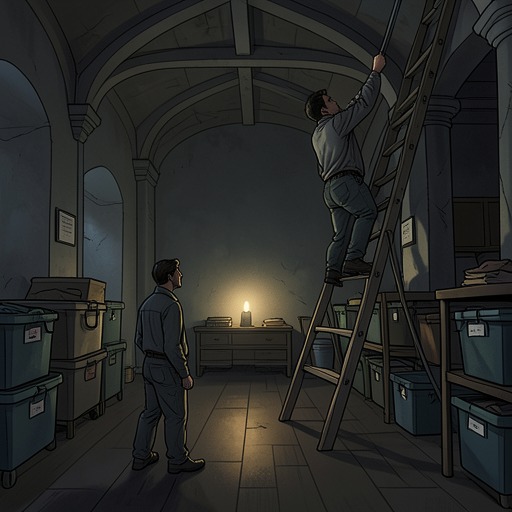
Back on the cellar floor, Scott first turns away from the window, unable to bear the view of sky and trees that he believes he will never reach. His attention returns to the Net pole leaning against the cliff wall. He suddenly sees it not simply as a piece of equipment but as a possible path up the steep cellar wall. The change comes after a period in which he had struggled to survive by climbing threads, killing spiders, and searching for food. Rather than accept that those efforts have brought him nowhere, he identifies a new use for an object already present in the cellar.
Climbing the cellar wall
Scott runs toward the pole, but his immediate needs remain part of the attempt: before reaching the net, he encounters the Cellar hose and drinks from it. He then climbs the metal rim of the net, passing its thick cords until he reaches the pole and pulls himself onto its broad, curved surface. Its width and shallow angle make it possible to move upward in a more upright position instead of having to climb with his hands pressed to the surface for support. The pole thus changes a difficult wall into a gradual route, though the ascent still takes effort.
As he climbs, Scott wonders whether the circumstances of his survival might have purpose. The thought is tied to two concrete events: the pole was left in this position by his brother, Marty, and the spider’s death the previous day had supplied what Scott now regards as the final key to escape. He considers whether their combination could be more than chance, while also recognizing that desire may be shaping his interpretation. The thought does not establish that his survival has a purpose; it gives expression to the excitement that accompanies a route finally opening before him.
His excitement grows as he passes the first and then the second lawn chair. After stopping to look down at the cellar floor, he continues upward and reaches the top of the wall an hour later, exhausted. He gets up again because darkness is approaching and he wants to leave before it falls. The escape is not completed by reaching the top: it requires him to continue across the cellar and negotiate the obstacles beyond the wall.
Across the cellar and through the window
Scott runs across the shadowed floor and passes the spider’s body without stopping. Its death matters as an earlier condition of the escape, but he now treats it as a step already taken rather than a destination. He pauses only to pull off a piece of bread and tuck it beneath his Sponge platform, then continues. This small supply-gathering detour shows that even in the rush toward the exit, survival still means attending to food as well as movement.
At the Giant spider web, Scott rests and begins the climb. The web’s sticky cables require him to pull his hands and feet free before moving to the next strand, and it sways beneath his weight. He passes a dead beetle without looking at it, concentrating on the climb and breathing through his mouth. Once at the top, he reaches the wooden shelf running along the wall and can run again. He follows the shelf’s dark path, turns around a corner, and continues along a beam until he runs into blinding light. The sequence makes the escape a crossing of several different surfaces and scales: the sloping pole, the web, the shelf, the beam, and finally the window.
Scott stops in the light and feels the wind across his face. He understands that he is outside. Then, slowly and carefully, he pulls himself up the few inches to the open square of the window, climbs over its wooden rim, and jumps down. He crosses the cement walk on unsteady legs and stops at what he experiences as the edge of the world. Reaching the window is not merely an ascent to a higher point in the cellar; it is the moment he passes beyond the house’s boundary.
Escape and its limits
The escape reverses Scott’s immediate predicament: the window that once marked an unreachable opening becomes a threshold he has crossed. That reversal depends on his reading of the cellar as a series of traversable routes rather than an entirely sealed space. The pole, the net, the web, and the beam do not cease to be obstacles; through repeated attempts and changes in approach, they become parts of a route out. His movement from the cellar floor to the window gives practical form to the persistence that had earlier kept him climbing, hunting, and looking for food.
Yet escape does not end the underlying danger. Scott knows that his body is still shrinking and believes that he has only the present day left. His reflections on possible purpose remain uncertain, and reaching the open air does not reverse that condition. The ending instead sets confinement against vastness: he has passed through a window and reached the outdoors, but his scale leaves the world around him almost immeasurably large.
Afterward, Scott finds shelter among dry leaves beneath the porch, gathers more leaves over himself, and drinks from a dish of water. He lies looking at the stars and takes comfort in their unchanged appearance, which remains familiar despite his altered size. Though this is the night he expects his life to end, he feels no terror and is glad to be alive. The escape therefore does not promise rescue from his final condition. It gives him the freedom to meet that condition outside the cellar, with the night sky above him and a renewed sense that being alive still matters.